Schema Markup Statistics 2026
Schema markup is no longer a niche SEO tactic; it is infrastructure for the modern web. Google's own public schema.org usage data from May 2026 tracks 958 distinct schema.org types and 4,587 properties appearing in live markup across the web, while the HTTP Archive Web Almanac shows JSON-LD now present on 41% of all pages. Below is a current, source-backed snapshot of how structured data is actually used in 2026, and what it means for your pages.
Key schema markup statistics at a glance
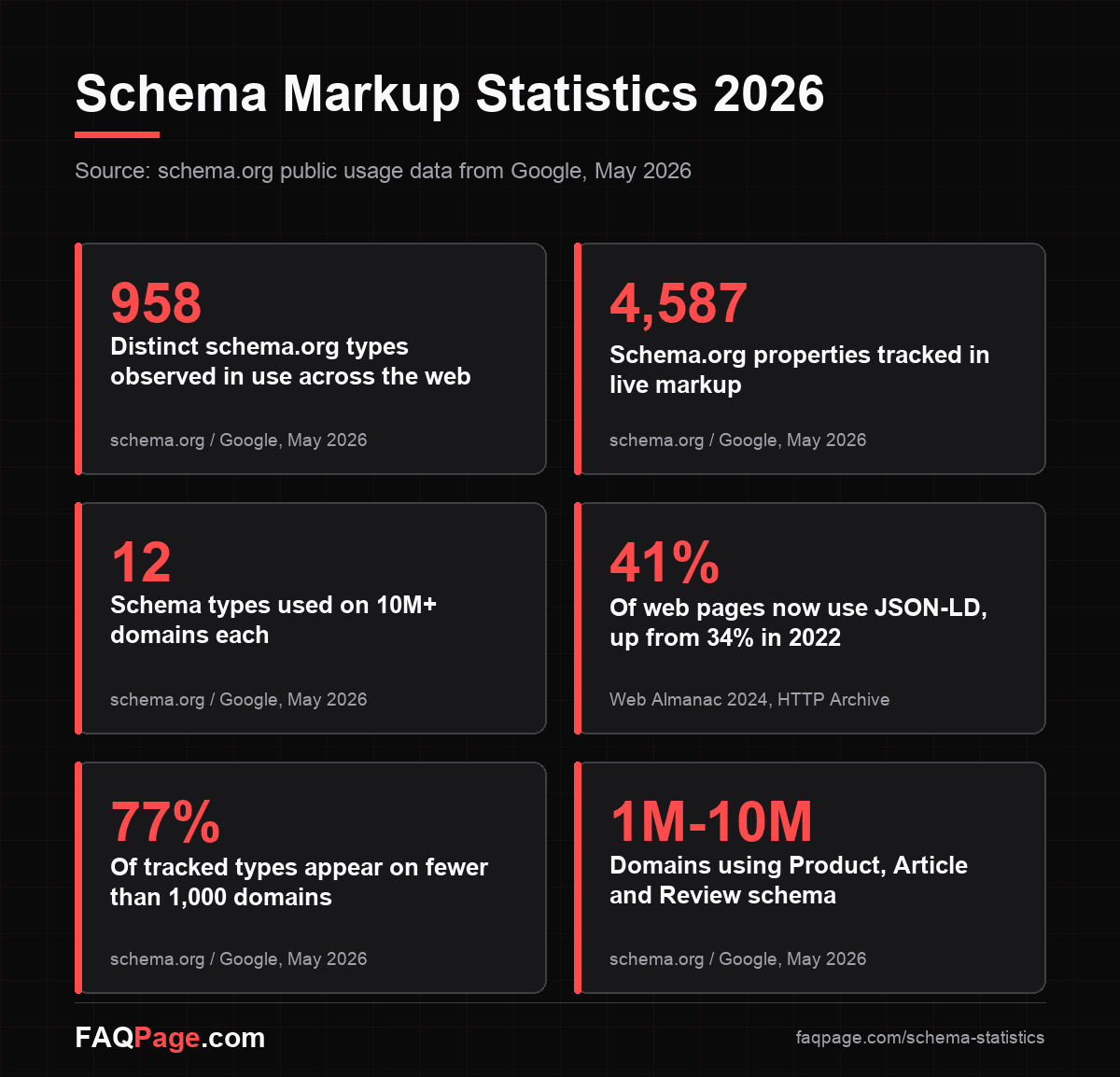
- 958 schema.org types and 4,587 properties were observed in live use in Google's May 2026 public schema.org dataset.
- Only 12 schema types are used on 10 million or more domains each (Google, May 2026).
- JSON-LD reached 41% of pages in 2024, up from 34% in 2022 (Web Almanac).
- About 77% of all tracked types and properties appear on fewer than 1,000 domains, a very long tail (Google, May 2026).
- The most common JSON-LD type is WebSite (12.73% of pages), followed by Organization (7.16%) and LocalBusiness (3.97%) (Web Almanac).
- FAQPage, Product, Article, and Review all sit in the 1M–10M domain tier (Google, May 2026).
Where these numbers come from
Most schema statistics floating around the web are recycled from years-old blog posts. The figures on this page come from primary sources. The headline dataset is the schema.org public usage file that Google publishes, refreshed for May 2026. It is a large CSV that lists every schema.org type and property Google encountered while crawling, bucketed by how many distinct domains used it. We pair that with the HTTP Archive Web Almanac, which measures structured data across millions of real pages and reports adoption as a percentage of pages rather than domains.
The two methods answer different questions. Domain buckets tell you how widely a type has spread across the web; page percentages tell you how dense that adoption is. Read together, they give an honest picture of which structured data actually matters in 2026.
Schema adoption by domain tier (May 2026)
Google's dataset groups every type and property into domain buckets. The distribution is steeply top-heavy: a tiny handful of types are nearly universal, and the overwhelming majority are rare.
| Domain bucket | Schema types | Properties |
|---|---|---|
| 10M+ domains | 12 | 31 |
| 1M – 10M domains | 35 | 65 |
| 100K – 1M domains | 39 | 119 |
| 10K – 100K domains | 151 | 269 |
| 1K – 10K domains | 236 | 324 |
| Fewer than 1K domains | 485 | 3,779 |
Of the 958 types, just 12 reach the 10M+ tier and only 35 more reach 1M–10M. That means fewer than 5% of all schema.org types are used on a million or more domains. At the other end, 485 types, just over half, appear on fewer than 1,000 domains each. The property long tail is even more extreme: 3,779 of 4,587 properties (82%) are sub-1,000-domain rarities. The lesson for site owners is simple: implement the handful of types that search engines and AI systems actually consume, and do them well.
The 12 near-universal schema types
According to Google's May 2026 data, only twelve types are used on 10 million or more domains. These are the structural backbone of the semantic web:
- WebSite, WebPage, and Organization (site and brand identity)
- BreadcrumbList and SiteNavigationElement (navigation)
- ImageObject, ListItem, and Person (content building blocks)
- SearchAction, EntryPoint, ReadAction, and Thing (actions and the root type)
Notice what is not on the list: none of the "rich result" content types. Those live one tier down, which is exactly where the interesting SEO opportunity sits.
Content schema in the 1M–10M tier
The 1M–10M domain tier is where commercial structured data lives. In Google's May 2026 data it includes Product, Article, Review, BlogPosting, LocalBusiness, VideoObject, Offer, AggregateRating, and FAQPage. The fact that FAQ markup ranks alongside Product and Article is striking, and it is the subject of our dedicated FAQ schema statistics page.
By comparison, types that get a lot of SEO attention are far rarer. Event, JobPosting, NewsArticle, HowTo, and HowToStep all sit in the 100K–1M tier, and Recipe is down in the 10K–100K tier. If you operate in one of those categories, comprehensive markup is a genuine competitive edge because so few of your competitors implement it well.
JSON-LD has won the format war
The Web Almanac found JSON-LD on 41% of mobile pages in 2024, up from 34% in 2022, a seven point jump in two years. Microdata, the older inline format, sat flat at 26%, and microformats2 stayed below 1%. Google recommends JSON-LD precisely because it decouples the structured data from the visible HTML, which makes it easier to generate, audit, and keep in sync. If you are adding schema today, JSON-LD in a script tag is the right default; our free FAQ schema generator produces exactly that.
The same report ranks the most common JSON-LD types: WebSite leads at 12.73% of pages, then Organization at 7.16%, LocalBusiness at 3.97%, ItemList at 2.44%, and Product at 0.77%. The steep drop-off after the top two mirrors the domain-tier data: a few types are everywhere, and everything else is comparatively scarce.
Why schema markup matters more in 2026, not less
2026 has been a year of recalibration. Google retired FAQ rich results on May 7, 2026, which led some teams to ask whether structured data still pays off. The data says yes. Even after losing its rich result, FAQPage adoption kept climbing, and the universal types that power knowledge panels, sitelinks, and entity understanding are more entrenched than ever.
The reason is that structured data is increasingly consumed by AI answer engines and large language models, not just by the ten blue links. A page that clearly declares what it is, who published it, and how its content is organized is easier for any machine to summarize and cite. Schema markup has quietly shifted from a rich-result lever to a comprehension layer for the entire search and AI ecosystem.
Want to add structured data the right way?
Generate valid, Google-ready JSON-LD for your FAQ content in seconds, no coding required.
Try the Free FAQ Schema Generator →A note on methodology
Google's public dataset reports adoption in ranges (domain buckets), not exact counts, so the figures here describe orders of magnitude rather than precise totals. The Web Almanac measures a large but finite sample of pages and reports mobile results unless noted. Both are refreshed periodically; the schema.org file used here is the May 2026 edition. You can inspect the raw data yourself in the schema.org public stats CSV.
Related Articles
- FAQ Schema Statistics 2026
- FAQ Schema Markup: What It Is & How to Add It
- FAQ Schema Examples: Code Samples & Best Practices
- FAQ Rich Results in 2026: What Still Works After Google's Updates
Put these statistics to work
Audit your existing structured data or generate fresh JSON-LD markup with our free tools built for FAQ pages.
Generate FAQ Schema Free →