FAQ Schema Statistics 2026
FAQ schema is having a paradoxical year. According to Google's own public schema.org usage data from May 2026, the FAQPage type now sits in the 1M–10M domain tier, the same league as Product and Article, yet Google ended FAQ rich results on May 7, 2026. Adoption is at an all-time high exactly as the visible reward disappears. Here is the current, source-backed data on where FAQ schema stands and why it still belongs on your pages.
Key FAQ schema statistics at a glance
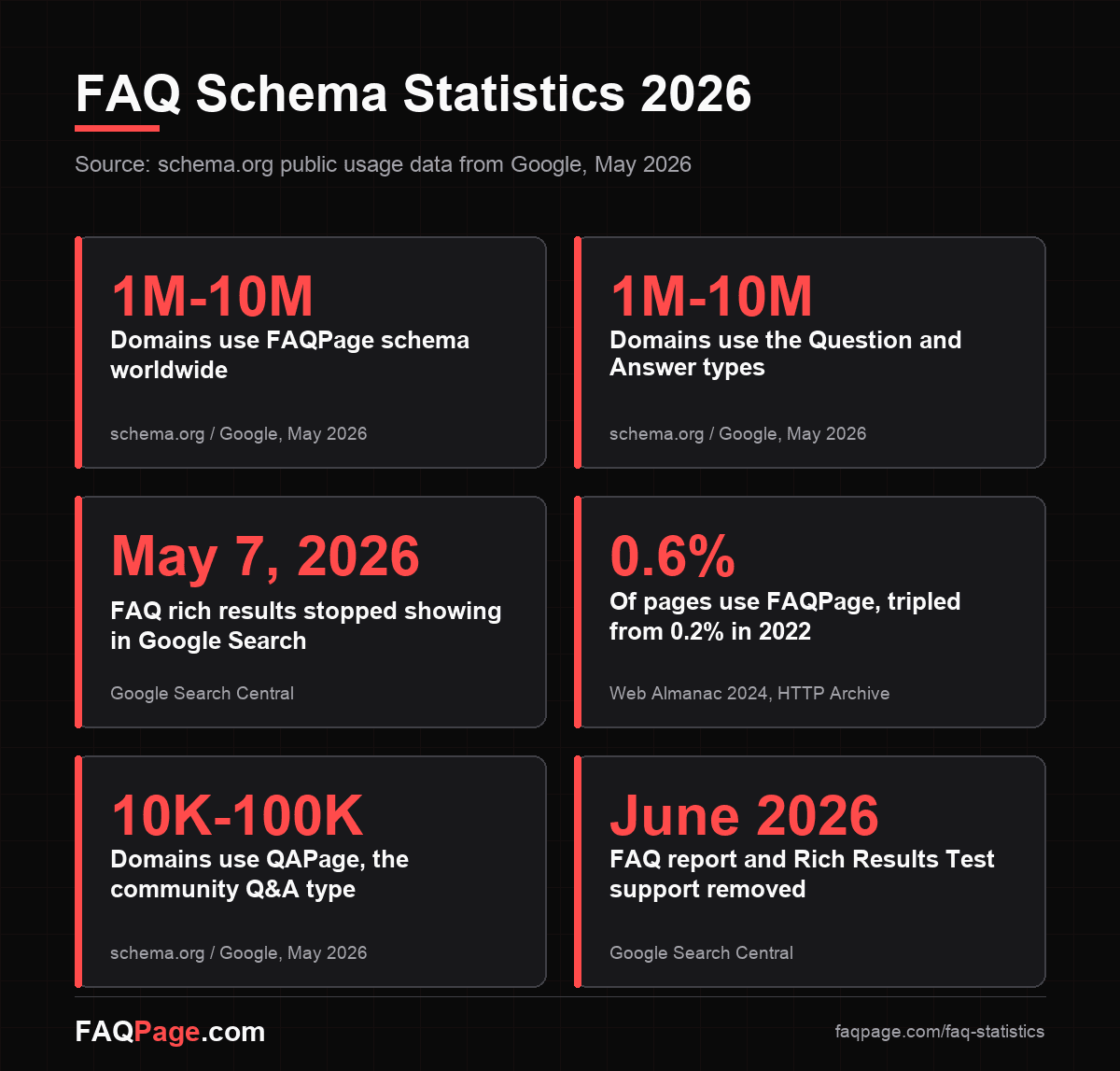
- FAQPage is used on 1M–10M domains worldwide (Google schema.org data, May 2026).
- The Question and Answer types also sit in the 1M–10M tier, as do the acceptedAnswer and mainEntity properties (Google, May 2026).
- FAQPage adoption tripled, from 0.2% of pages in 2022 to 0.6% in 2024 (Web Almanac).
- FAQ rich results ended May 7, 2026 in Google Search (Google Search Central).
- The community QAPage type is far rarer (10K–100K domains) than FAQPage (Google, May 2026).
- FAQ tooling (report and Rich Results Test) is removed in June 2026; Search Console API support ends in August 2026 (Google).
How widely is FAQ schema used in 2026?
Very widely. Google's May 2026 public schema.org dataset places FAQPage in the 1M–10M domain bucket. To put that in context, that is the same tier as Product, Article, Review, BlogPosting, and LocalBusiness, and a tier above Event, JobPosting, and NewsArticle. FAQ markup is one of the most widely deployed content schemas on the web, not a fringe tactic.
The Question and Answer types ride along in the same 1M–10M tier, which makes sense because a valid FAQPage nests Question items, each with an acceptedAnswer. Those supporting properties, acceptedAnswer, mainEntity, and text, all appear in the 1M–10M tier too. The implementation pattern is consistent and well understood across millions of sites. If you need the exact structure, our FAQ schema examples show copy-paste JSON-LD.
FAQ schema adoption by type and property
Here is the full FAQ-related cluster from Google's May 2026 data, ranked by how many domains use each type or property.
| Schema item | Kind | Domains |
|---|---|---|
| FAQPage | Type | 1M – 10M domains |
| Question | Type | 1M – 10M domains |
| Answer | Type | 1M – 10M domains |
| acceptedAnswer | Property | 1M – 10M domains |
| mainEntity | Property | 1M – 10M domains |
| text | Property | 1M – 10M domains |
| answerCount | Property | 100K – 1M domains |
| QAPage | Type | 10K – 100K domains |
| suggestedAnswer | Property | 10K – 100K domains |
| upvoteCount | Property | 10K – 100K domains |
Two things stand out. First, the gap between FAQPage (1M–10M) and QAPage (10K–100K) is roughly a hundredfold. QAPage is for community question-and-answer pages where users post competing answers, like a forum thread, and the suggestedAnswer and upvoteCount properties that support it are correspondingly rare. Most sites want FAQPage, not QAPage. Second, the supporting properties scale with their parent types, a sign that the markup is being implemented correctly rather than half-completed.
FAQ schema adoption has tripled since 2022
The Web Almanac measured FAQPage on 0.6% of desktop pages in 2024, up from 0.2% in 2022, a threefold increase. What makes that remarkable is the timing. Google had already restricted FAQ rich results to authoritative government and health sites back in August 2023, so the bulk of that growth happened after the obvious SEO incentive was taken away. Site owners kept adding FAQ schema anyway, because the structure is useful beyond a single SERP feature.
The end of FAQ rich results: what changed in 2026
On May 7, 2026, Google completed a multi-year wind-down. Google Search Central confirms that FAQ rich results no longer appear in Search. The broader timeline is:
- August 2023: FAQ rich results limited to well-known, authoritative government and health websites.
- May 7, 2026: FAQ rich results stop appearing in Google Search entirely.
- June 2026: the FAQ search appearance filter, the rich result report, and Rich Results Test support are removed.
- August 2026: support for the FAQ rich result in the Search Console API is removed.
Google's guidance is that existing FAQ structured data can stay in place; it will not cause problems, it simply will not generate a visible rich result. We cover the practical fallout in detail on our FAQ rich results page.
Why FAQ schema still matters in 2026
If the rich result is gone, why are millions of domains keeping FAQ schema? A few reasons that the data supports:
- Machine comprehension. Structured data makes the question-and-answer structure explicit for search crawlers and AI answer engines, which increasingly summarize and cite web content directly.
- Other surfaces. Google is not the only consumer of schema. Other search engines, voice assistants, and LLM-based tools read the same markup.
- Content discipline. Marking up FAQs forces clear, self-contained questions and answers, which is good for users and for featured-snippet-style extraction.
- Future-proofing. Search features come and go. The cost of keeping valid markup is near zero, and it positions pages for whatever comes next.
Generate valid FAQ schema in seconds
Our free tool builds clean FAQPage JSON-LD from your questions and answers, ready to paste into any page.
Try the Free FAQ Schema Generator →A note on methodology
Google's public dataset reports adoption in domain ranges rather than exact counts, so "1M–10M domains" means the type was seen on somewhere between one and ten million distinct domains. The Web Almanac reports a percentage of a large sample of pages, with desktop figures cited here for FAQPage. For the broader picture of every schema type, see our companion schema markup statistics page, and you can review the raw numbers in the schema.org public stats CSV.
Related Articles
- Schema Markup Statistics 2026
- FAQ Rich Results in 2026: What Still Works After Google's Updates
- FAQ Schema Markup: What It Is & How to Add It
- Do FAQ Sections Improve SEO? The Data-Backed Answer
Put these statistics to work
Audit your existing FAQ markup or generate fresh, valid JSON-LD with our free FAQ tools.
Generate FAQ Schema Free →